

Prof. Dr. Stefanie Bailer
ProfessorHead of the department
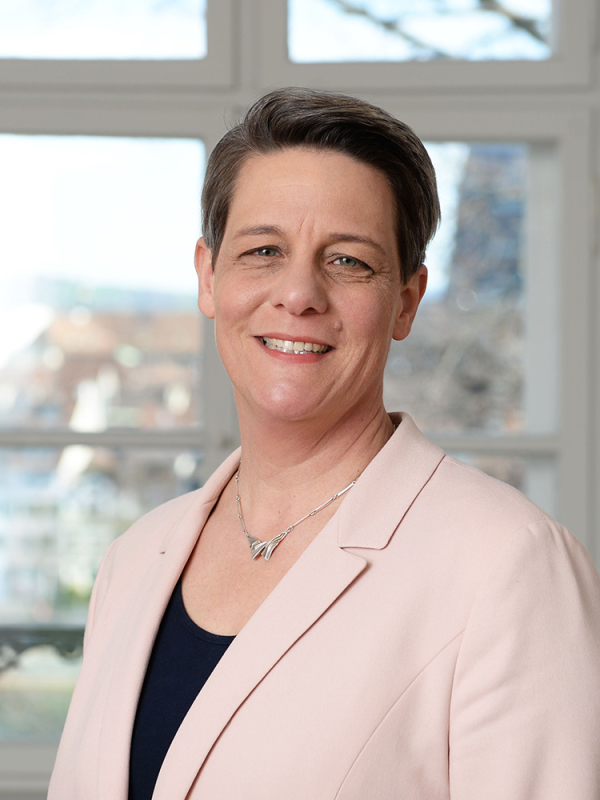
Professor
Fachbereich Politikwissenschaft
Bernoullistrasse 14/16
4056 Basel
Schweiz
Head of the department
Curriculum Vitae
Stefanie Bailer has been professor of political science at the University of Basel since November 1, 2015. Prior to that, she worked as an assistant professor of global governance at ETH Zurich (2009-2015) and as senior assistant professor at the University of Zurich. Since her PhD (2004) on "Power and Success in the EU Council of Ministers" at the University of Konstanz (with research stays at the Rijksuniversiteit Groningen and University of Michigan), she has devoted herself to the research areas of parliamentarism in Germany, Switzerland and Europe, decision-making processes in the European Union, and international negotiation analysis. Within these research topics, she analyzes the decision-making processes of political actors, and the way their decisions are influenced by institutions.
Publications
ALL PUBLICATIONSProjects
ALL PROJECTSUniversity courses, fall semester 2026
Monday, 12.15-13.45 – Bernoullistrasse 14/16, Seminarraum 02.004
Dienstag, 10.15-11.45 Uhr, Kollegienhaus, Hörsaal 118
In dieser Vorlesung werden zentrale Fragestellungen und Forschungsperspektiven der Vergleichenden Politikwissenschaft vorgestellt und analysiert. Als Arenen der Macht werden in einem ersten Teil politische Systeme und die Bedingungen und Folgen verschiedener demokratischer Regimetypen vorgestellt.
In einem zweiten Teil werden die Akteure der Macht in einem politischen System präsentiert und analysiert: Regierungen, Parteien, Medien, ParlamentarierInnen, Interessengruppen, BürgerInnen. Wir untersuchen, inwieweit, diese Akteure ihre Interessen in einem politischen System vertreten und von welchen Faktoren ihr Einfluss abhängt. Dazu gehören beispielsweise institutionelle Gegebenheiten wie Wahlsysteme und Parteiensysteme.
Anhand dieser Vorlesung werden die Grundlagen der Vergleichenden Politikwissenschaft vermittelt und ein Verständnis für zentrale Fragen in der Politik entwickelt. Ein Schwerpunkt in der Vorlesung liegt auch in der Anwendung mit Beispielen und Anwendungsfällen, insbesondere aus dem europäischen Raum.
Lernziele
- Kennenlernen zentraler theoretischer Konzepte und Klassifzierungen der Vergleichenden Politikwissenschaft
- Analyse politischer Systeme und Akteure in der Schweiz und anderen westeuropäischen Ländern
- Anwenden der Konzepte und Theorien anhand von Beispielen
Thursday, 10.15-11.45 – Bernoullistrasse 14/16, Seminarraum 02.004
Lecturers
Stefanie Bailer (stefanie.bailer@clutterunibas.ch, BeurteilerIn)
Manfred Max Bergman (max.bergman@clutterunibas.ch)
Janina Grabs (janina.grabs@clutterunibas.ch)
Tobias Hagmann Leupin (tobias.hagmann@clutterunibas.ch)
Denise Traber (denise.traber@clutterunibas.ch)
Course content
This introductory obligatory course for MA students offers an introduction to the key topics of inequality, power, resources, and conflict. It introduces theories and approaches from political science, international relations, and sustainability studies. In addition, the course offers an overview of empirical applications with social science methods. The students will learn about the basic concepts and theoretical approaches and gain an overview of current research on the above-mentioned topics. The course is a prerequisite for participation in seminars in the MA Political Science “Inequality, Power, Conflict” and the Changing Societies Module “Sustainable Societies: Inequality, Power, Conflict”.
Learningobjectives
- explain key concepts of inequality, power, resources, and conflict.
- compare major theoretical approaches across political science, international relations, and sustainability studies.
- identify and formulate relevant research questions connected to contemporary debates on inequality, power, and sustainability.
Lecturers
Stefanie Bailer (stefanie.bailer@clutterunibas.ch, BeurteilerIn)
Sophie Suda (sophie.suda@clutterunibas.ch)
Course content
This seminar introduces students to survey research in political science. Focusing on key methodological challenges—including sampling, question wording, answer formats, and the measurement of sensitive topics—students learn how survey design shapes empirical findings. Through group work and practical exercises, the seminar emphasizes the development of novel survey instruments and improved measurement strategies.
Learning objectives
- Assess the strengths and limitations of survey questions with regard to validity, reliability, and cross-national comparability.
- Analyze how survey design choices (e.g., wording, answer categories, context) influence empirical findings.
- Apply principles of good survey design to develop and justify their own survey questions or measurement strategies.
Remarks
Advanced BA 5th & 6th semesters onwards, MA students
All Seminars will be graded in the Department of Political Science.
Grading scale 6.0 to 1.0, whereupon 4.0 is a pass.
The number of participants is limited. The places are assigned according to date of enrollment and subject of study. Priority will be given to students of Political Science.
Office hours
Please register via PhilApp for an appointment.
Co-Workers
Quick Links